Showing posts with label Marriage. Show all posts

Friday, 30 September 2016

The Theology of Christian Marriage


Marriage: an Orthodox view
The Orthodox Church understands marriage as a holy mystery (sacrament); the union of two human persons, one male and the other female, as a sign of the love of Christ for the Church, fulfilled in the Kingdom of God. There can be no such thing as a homosexual marriage.[1] 


1 Introduction

Christian theologians do not seem to have paid very much attention to marriage in the past. There have not been such clearly worked out dogmatic definitions for marriages as there have been, for example, in Christology.


Saturday, 14 June 2014

The Orthodox Christian Marriage

 
by Priest Alexey Young 
 

Orthodox Christianity is a way of life, not merely something we do on Sunday mornings and quickly forget when we leave church. A way of life is a whole coming together of habits and attitudes, ideas and actions: a style of life, a way to live. For us Orthodox, Christianity is our daily bread. Like a fish in water, we must swim in our Faith. As followers of Christ, we take our whole direction from Christ and His Church, and not from the standards of today's world. This seems clearest when we visit a monastery, where the environment, the atmosphere, the focus of life - everything is clearly and deliberately Orthodox. 


Most of us Orthodox Christians do not live in monasteries; we are married; we have homes, children, jobs. Among many married Orthodox there exists the mistaken idea that their following Christ does not require the same dedication required of the Orthodox monastic. But of course all Christians, whether monastic or not, are equally called by Christ to repentance and eternal salvation. There are no "classes" of Orthodox Christians - all are equal and all are expected to be followers of Christ, regardless of their position in the Church. 


It is, however, very difficult for us non-monastic Christians to live an Orthodox life-style from day to day and year to year because we are constantly exposed to and live within a society that is not only not Christian but even at times, and increasingly, hostile to Orthodox Christian beliefs.  But this should not discourage us, for Christ Himself understood this situation when He said: Behold, I send you out as sheep in the midst of wolves; be wise as serpents and innocent as doves (Matt. 10:16). 


A tremendous bastion of strength for Orthodox lay people in our circumstances is marriage and family life, a state that has been blessed by God for the salvation of each individual member of the family. In order fully to understand this, we must look at the doctrinal foundations of marriage found in Scripture and Sacred Tradition - which are the on-going conscience of the Church. 


The Old Testament and the New Testament Views of Marriage 

Wednesday, 30 April 2014

….An Image of the Trinity

                          
  Introduction
 
 
The Sacrament of Marriage does not unite a man and a woman. Rather, it is the Church’s recognition of a union that God has already begun to work in their lives. As long as the union remains within the reality of this world, it will be subject to sin, pain, and death.  But, through the sacrament, the union enters at the same time into a new reality: that of God’s Kingdom. In Christ, marriage is restored to its initial perfection and in the sacrament, this union is made open to the possibility of what God intended marriage to be from the beginning: an eternal life of joy in union with Him.
Thus, marriage goes beyond a legal contract. There is no exchange of vows – the two have freely and coequally committed to one another and consented to God’s presence in their union. There is no phrase “’til death do us part”. If marriage is brought into the Kingdom of God, death, as a separation, is powerless over it. Christ has destroyed death by His Cross and Resurrection; therefore, the union of man and woman in Christ is eternal.

The Exchange of the Rings 
 
The Orthodox Sacrament of Marriage actually consists of two parts: The Exchange of Rings and The Crowning.
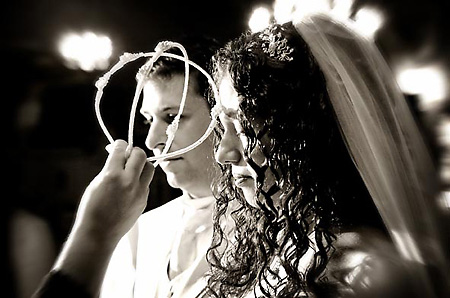
This first part of the wedding service can be equated with the ‘civil service’. It takes place in the vestibule (entry) of the church; that area seen by the Church as the closest to the ‘outside’ world.  In this service the Church first prays for the couple.  Here the Church recognizes and blesses a union which has begun “in the world” yet awaits fulfillment in the world to come. After being blessed by the priest, the rings are placed on the right hand, the hand with which promises and/or oaths are traditionally made and the hand with which the presence of God is recognized through the sign of the Cross.  The rings, of course, are the symbol of betrothal, agreement, authority, and stewardship from the most ancient times.  The exchange of the rings gives expression to the fact that in marriage the spouses will constantly be complementing each other.  Each will be enriched by the union. The exchange of rings represents a pledge to share and exchange both their physical and spiritual goods, a pledge of eternal love and devotion.

The Procession 
 
After the Exchange of the rings the priest leads the couple in procession into the middle of the church. The priest chants Psalm 128, “Blessed is everyone who fears the Lord, who walks in His ways…” This psalm is one of the “Psalms of Ascent” sung by Jewish pilgrims on the way to the Jerusalem Temple. This point in the service most clearly reveals the “action” of the sacrament. The couple brings themselves, each other, their lives, and all that fills their lives, to the altar as an offering to God. As the couple enters into the midst of the Church, their relationship enters into the new reality of God’s Kingdom.

Declaration of Intent and Lighting of Candles 
 
Having processed into the church, the couple must individually proclaim, before the assembly, that they have come freely, without constraints or prior commitment, to be joined by God as husband and wife.
The bride and groom are then handed candles which are held throughout the service.  The candles represent the couple’s faith and willingness to follow the Light of Truth, Jesus Christ, and that they will have their way through life lighted by the teachings of the Church.


The Crowning 
 
After prayers are offered on their behalf, the groom and bride are crowned by the priest “In the Name of the Father and of the Son and of the Holy Spirit”.  These crowns have two meanings.  First, they reveal that the man and woman, in their union with Christ, participate in His Kingship.  Second, as in the ancient Church, crowns are a symbol of martyrdom.  The word “martyr” means witness. The common life of the bride and groom is to bear witness to the Presence of Christ in their lives and in the world. Martyrdom is usually associated with death.  So the reality of God’s Kingdom in the life of the husband and wife will necessarily take the form of dying to one’s self, to one’s will, and the giving of one’s life totally to the other, and through the other, to Christ.

The Epistle 
 
The epistle is taken from St. Paul’s letter to the Ephesians (5:20-33). It presents the cornerstone of the Christian vision of marriage: the love of man and woman parallels the love of Christ and the Church. As Christ gives Himself totally to and for His Church, so the husband is to give himself totally to and for his wife. As the Church, in turn, is subject to Christ, so the wife subjects herself to her husband. Thus the two become one in a life of mutual love and mutual subjection to each other in Christ.

The Gospel 
 
The gospel, from John (2:1-11), is the familiar account of the Wedding Feast at Cana where Christ turns the water into wine. A person must drink water simply to survive.  Wine, on the other hand, is more than just a drink that quenches thirst and continues life.  Wine is associated with joy, with celebration, with life as being more than mere survival.  By His presence at this wedding He changes the union of man and woman into something new.  Marriage becomes more than a mere human institution, existing for whatever purpose a society assigns it.  It becomes, like the Church Herself, a sign that God’s Kingdom has already begun in our midst.

 The Common Cup and the Dance of Isaiah 
 
After more prayers, a common cup of wine is blessed and shared by the couple as a sign of their common life together, a sharing of joys and sorrows, successes and failures, hopes and fears.
This is followed by the triple procession around the center table: the Dance of Isaiah. The hymns return once more to the theme of martyrdom and union with Christ. These are the hymns that, since ancient times, the Church has used to emphasize God’s blessings.  They are the same ones sung at ordinations into clergy orders and signify that this couple has been set apart from the mundane world to live a life in Christ.
Throughout the service things are done in threes in remembrance of the Trinity.  Man is made in the image and likeness of God. Marriage is intended by God to be an image of the Trinity.  It is the union of three persons, not two.  Man and woman are one with each other and one with the person of Jesus Christ.

Removal of the Crowns 
 
At the end of the service, the crowns are removed and the priest prays that God will receive these crowns into His Kingdom. The reality of the Kingdom into which the bride and groom have entered is not completely fulfilled, but only begun. Husband and wife must receive God’s Kingdom and make it both a present reality and a challenge and goal of their common life.  Completion and fulfillment will come when Christ returns in power and glory to complete the establishment of His Kingdom in this world by filling all things with Himself.

The Greeting of the Couple 
 
At the end of the service, the couple stands at the foot of the altar. From the beginning, at the back of the church, they have now progressed to the forefront. Only the eternal Kingdom of Jesus Christ, as signified by the Altar, remains ahead of them. Their final act is to turn and face the assembled Church. Through this sacrament, they have become an icon of the Church and icon of Christ and the assembly comes up to congratulate them and share in their joy.

Source:Pravmir.com

Thursday, 25 July 2013

St. Gregory the Theologian’s Advice to a New Bride


We are in Constantinople, in 384 AD. There is a festive event taking place: the wedding of two well-known youths of that time. They are both from upper class families.
The bride, Olympiatha, is a remarkable young lady, quite wealthy and a descendant of the imperial family. She is an orphan whose uncle Prokopios (an eparch of the Imperial State that is also her protector) undertook the responsibility for all of the wedding arrangements, including the invitation list. Olympiatha is marrying a wonderful man by the name of Nevrithios who is the eparch of Constantinople and overseer of the imperial fields.
According to the historians of that time, all of the “who is who” are in attendance of the wedding ceremony, including a sizeable group of bishops. St. Gregory the Theologian (the Patriarch of Constantinople and spiritual father of the bride) is unable to be present due to personal illness. He sent a personal letter to Prokopios expressing his regrets for being unable to attend due to illness. As the spiritual father of Olympiatha, he is pleased about the wedding and passes in writing his immense joy about the wedding of the “golden Olympiatha.” He calls her golden not because of her immense family wealth but rather her golden heart that is evident in the bride’s character and demeanor. In his letter, St. Gregory refers to her as “my child,” i.e., my spiritual child; as such, he is in position to know the depth of her character and quality of her soul as no one else.
Within his letter to Prokopios, he writes that “I am next to you, celebrating the event, and with you I place the right hand of the one youth upon the right hand of the other and then both of them upon the hand of God.”
Later on, St. Gregory sends to the young bride an original wedding gift: a poem with 111 verses, written in ancient Greek and with quite old-fashioned language (even for that time). Through this gift, he passes to his spiritual daughter the wisdom of pertinent advice and thus paints the ideal type of an Orthodox Christian wife. The poem is being translated in open format, and I pray that the saint forgives this transgression for taking such freedom with his wise writings.
† † †
My daughter,
For your wedding, I, your spiritual father Gregory, offer you this poem as a gift. And I consider it to be the best possible advice a father could offer to his beloved daughter.
Listen to me Olympiatha: I know that you desire to be a true Christian. As such, be aware that a true Christian must not only be one but she must also appear accordingly. This is why I ask you to pay special attention towards your personal appearance. You must be simple! Gold, attached to precious stones, does not add any value to women of your stature. This is even more so with make-up. It is very improper for you to alter your face, which represents an image of God, for the sole purpose of attraction and admiration by others. Know that this constitutes vanity that is unbecoming of a young lady of your character. I therefore ask that you overcome the feminine vanity that is abundant among young ladies of our time and remain simple in your appearance. The expensive and fancy dresses must remain for those women that have no desire for the life beyond and do not know what the meaning of spiritual struggle and attainment of virtues is all about; this type of woman cannot possibly comprehend the spiritual radiance and brilliance of a life in Christ. You have aimed towards greater goals and for a higher purpose for your life. These goals demands your full and undivided attentiveness and care.
First of all, you must respect and love God and immediately after Him you must respect and love your husband in the same manner as our Lord and Savior and in accordance with the instructions of our Holy Gospel. I thus ask you, how is it possible for a woman to love her husband in this manner if she has not met, has not respected and has not loved Her Lord and Creator in this same manner?
In your marriage, fondness, affection and love must be strong and persistent for him whom God has selected to be your life partner. This man is now the eye of your life and the delight of your heart. And if you ever perceive that your husband possibly loves you more than you love him, do not take advantage of his feeling by attempting to gain the upper had in your marriage. That is plainly wrong as it is totally against the writings of the Holy Gospel!
You must respect him and love him unconditionally, as you love God. Be aware that you are a woman and you have an important and great purpose and destiny; however, your purpose and destiny is different than that of your husband who must be the head of your household. Set aside the silliness of equality among the sexes, that some of your contemporaries preach, and attempt to comprehend the obligations of marriage. In the realization of these obligations you will discover the great patience and endurance that is necessary to fulfill your family duties; it is in this manner that you will also discover the great strength that you as a woman possess.
You must surely be aware of how easily anger overtakes men. They cannot maintain and they often appear as wild lions. It is at this exact moment that a woman must remain stronger and display her superiority. You must play the role of the lion-tamer. What does a lion-tamer do when the beast starts roaring? He becomes even calmer than usual and through kindness and persistence he overcomes his wrath. He speaks to him kindly, in a soft but firm voice, he caresses it, he attends to it, he pets it and little by little calmness is restored.
You must never criticize, scold or become derogatory towards your husband for something that he has erred. Likewise, you must avoid any contempt towards any inaction or indecision by your husband, even when the outcome is not favorable or something that you greatly desire or consider proper. Be aware that demons are always around attempting to penetrate your household, and break up the couple’s harmonious spiritual cohabitation.
You must share everything, joys and sorrows alike. The Holy Sacrament of Marriage has indeed made all common to both of you. This is equally important towards the daily obligations and duties as they apply to running the household; it is the only way that a strong foundation will be built for your marriage. Let both of you provide your views and opinions; in the end, however, allow your husband to have the final say.
When you observe your husband to be sorrowful, share in his sorrow and provide him the needed relief; the support of the person closest to you in moments of sorrow and despair is of great value and relief. Immediately, however, let your facial expressions become calm, clear and collected; let peace prevail upon your demeanor and forego the temptation of any thoughts of despair. The wife is the calm harbor for the sea wave-stricken husband.
Your presence within your home is irreplaceable; you must accordingly love your home with all the cares and concern of a dedicated housekeeper. You must view it and consider it as your kingdom and you should be judicious about how often you exit its entrance. Let your husband take care of many of the outside cares and obligations while you concentrate towards those within the home.
Be extremely careful with whom you associate and the company that you keep. Be especially careful of the social gatherings that you may be participating in. Do not allow yourself to enter entertainment centers of questionable background; these represent extreme danger towards your purity and the sanctity of your marriage. These types of social interactions remove the instinct of shame, eyes cross with eyes, and once shame is not there to guard from any impropriety, the demons are able to exercise their influence and give rise to evils of unspeakable magnitude.
On the other hand, social interactions with friends of substance and of firmly grounded spiritual state must be pursued. In this manner, words of value get implanted within you and you either benefit from them or are able to confront and resolve any weaknesses that you may recognize. Concurrently, you are able to cultivate social interests and get to know people who will benefit your household’s spiritual state.
Do not be anxious to keep company or even appear in public and in the company of others for no reason. You should instead dedicate your precious time in the company of your wiser and more prudent relatives, priests, and seriously-minded people, young and old alike.
Stay away from conceited and ostentatious women whose mind is pre-occupied with external appearances and social circles, all for the purpose of vainglory and public display. This should be the same for any men that you consider respectful and spiritual but whom your husband has not allowed to enter your home, irrespective of how highly you may regard them. For is there anything more precious for you than your good husband whom you love so dearly?
Your thoughts must aim high but you must never behave as intolerable or snobbish.
I applaud women that are known by only a few men. Do not run towards worldly feasts and celebrations, even when those are for weddings or birthdays. It is around those types of gatherings that the passions of the flesh are aroused with the many dances, the drinking, the laughter and the false joys that are capable of deceiving and misleading even the pure and the wise. Always remember that purity is extremely fragile—it is like bee wax exposed to the rays of the sun. It would be prudent to limit and at times avoid the worldly feasts, even within the confines of your own home. If we were capable of controlling the desires and many appetites of the stomach we would be well served in our struggles against the many passions of our flesh; we would be in a position to conquer them instead of being subdued by them.
Keep your face calm and collected and do not alter it with extreme laughter or with grimaces of dismay, anger or disappointment towards others. Your ears should be decorated not with pearls but instead with the sounds of proper language and with locks for all the improprieties that may enter your nous through them. Thus, whether they are open or closed your sense of hearing will remain pure.
As far as your eyes, they are the ones that display the contents of your soul. Let them be the source of blush and virgin purity that pours below your eye lashes. This way, your presence and eyesight will invoke modesty, decency and the shame of innocence to all that lay their eyes upon you, perhaps even your husband! It is best and for many reasons that you keep your eyes closed or indifferent to the events around you and you should make it a habit to always maintain your sight low.
And now for your tongue. Your husband will always be your enemy for as long as your tongue is uncontrolled, even if you are to be blessed with thousands of other talents. A foolish tongue often endangers even the most innocent of people. It is preferred to maintain quiet, even in cases that you are correct. This is because you risk the expression of an unintended improper word or characterization. No matter how greatly you desire to say a lot, it is best that you limit your words and instead choose your presence to be a quiet one.
Be attentive even of the manner that you walk; it matters greatly towards a prudent presence.
And now pay close attention and be mindful of the following advice: You must never exemplify or maintain an uncontrollable desire for the flesh. Persuade your husband to respect the holy days of the Church and the fasting periods. This is because God’s laws are of much greater importance than the image of God. Be mindful that the institution of marriage was established by the Son of God to aid His creation so that a balance is maintained, as some depart this world while others arrive.
If you have benefited from this old man through some spiritual words of value I ask that you keep these words and advice guarded well within the depths of your soul. In this manner, through everything that you have benefitted and through the grace of your moral stature, you will be capable of healing your excellent husband and well known politician from the evils of vainglory and pride that constantly surround him.
This is my gift and heirloom that I offer to you. And if you desire my blessing, I pray that you become a vineyard of descendants, with many children, and many children from these children, so that our God may be glorified by more of us, for it is for Him that we are born and to Him that we should aim our earthly paths.
Your spiritual father,
+Gregory
Patriarch of Constantinople

 Source: From the monthly publication «Ἐνοριακὰ Νέα» (“Parish News”), St. George Dionysou parish (northern Athens), translated from Greek by the staff of the Greek Orthodox Brotherhood of St. Poimen the Great.

Friday, 9 November 2012

How the Church Creates Spiritual Ties


The Church is the Body of Christ, and we are its members. The Apostle Paul teaches that each member must fulfill his duty for the good of all. This means that if we belong to the Church and follow Her statutes, we will continually strengthen our spiritual ties in Christ. This will come about through the Church's prayers, Mysteries, services and mutual fellowship.
      Chief meaning in the Church is given to the Mysteries, and for this reason we will examine their effects.

      The Mystery of Baptism – Through this Mystery of renewal, the Church unites the infant to a new life in Christ. It would seem that this Mystery has meaning only for the one being baptized, but if we consider the godparents, we will perceive a greater meaning in this sacrament. The godfather and godmother are drawn by the Church to participate in the Christian upbringing of the child, and thereby enter into new ties with the family of the baptized. After this, the Church considers them to be spiritual relatives of the family of the baptized and therefore forbids inter-marriage between them. Thus, with each new baptism, the foundation of the Church, the family, is strengthened. Even if not all godparents fully acknowledge their obligations, yet around every baptismal font new spiritual ties spring up between members of the Church.

      The Mystery of Communion – From the very earliest times of Christianity, this Mystery was looked upon as a means of maintaining spiritual ties between members of the Church. The Savior said: "He who eats My flesh and drinks My Blood abides in Me and I in him" (Jn. 6:56). The essence of this mystical unity is difficult to grasp, but leaves no doubt that all the faithful, through Holy Communion, enter into spiritual brotherhood through Jesus Christ. And when we say "brother-in-Christ" or write in a letter "with love in Christ," then we witness thereby to our spiritual kinship with other members of the Church. Such a spiritual tie between us goes far beyond all other human relationships, for it has an eternal, unsurpassable meaning. Therefore, the greater the number of the faithful that receive Holy Communion in a parish, and the more often they approach the Holy Chalice, the more the bonds of Christian love between them will be strengthened thereby.

      The Mystery of Marriage – By this Mystery the Church creates a family, a new cell of the faithful. In essence, a sort of spiritual miracle is performed in this Mystery: from two previously separate persons, the Church fashions the new ties of relationship between husband and wife. And in the Rite of Matrimony the priest prays for them: "O Eternal God, Who hast brought into unity them that were sundered, and hast ordained for them an indissoluble union of love, do Thou Thyself bless these, Thy servants, guiding them unto every good work."

      Although this "union of love" includes the physical unity, its chief sense is the spiritual union, after the model of Christ and His Church. And that there should always be of necessity mutual spiritual understanding between the groom and the bride in a Christian marriage, we have a direct indication in the following passage in the epistles of the Apostle Paul: "Have we not power to eat and drink? Hae we not power to lead about a sister, wife, as well as other apostles and brethren of the Lord and Cephas?" (I Cor. 9:5).

      This shows us that true Christian marriage can take place only between the faithful. In choosing for himself a partner for life, the groom must, above all, find for himself a "sister-in-Christ," and the bride a "brother-in-Christ," after which the Church unites them in the bonds of marriage for their whole life. This is the reason why the Church considers marriages with persons of different confessions undesirable, and still more so, with unbelievers. Such marriages, as it were, remain outside the general life of the Church and cannot be stable. Only a common faith can be a true foundation for marriage; and everything else will follow.

      The Mystery of Confession – In this Mystery new spiritual ties also appear between penitent and confessor. Here the confessor, appointed by the Church, becomes a spiritual father and takes upon himself care of his spiritual children. Thus, it is so important to have as one's spiritual father not just any priest, but a regular guide, as is done in monasteries. It is possible for laypeople to have such a regular confessor in the form of an elder to whom one commits oneself for his whole life. Thus, the Mystery of confession maintains the deep spiritual relationships between the clergy and the laity. But the spiritual father has a particularly great meaning for monastics, when they completely renounce the world and commit themselves to a spiritual father, who takes the place of their father and mother.

      Such is the meaning of the Holy Mysteries in the creation of spiritual ties within the Church, on the foundation of Christian love. They sustain the faith of members of the Church and strengthen their Christian life, both family and personal. In such conditions there cannot be the type of loneliness and neglect among Christians which is presently observed among people lacking any sort of spiritual bonds. Such unbelieving people marry and beget children, but all this has a casual and temporary character. Their marriages fall apart, their children are neglected and perish, both physically and spiritually. Even their family relationships are based not so much on love as on greedy calculation, in order to receive help, protection or an inheritance, and so as not to be left alone in their old age. And how many suicides are there today, that arise chiefly because of unbelief and the loneliness bound up with it?

From Orthodox Life, Vol. 28, No. 3 (May-June 1978), pages 20-31. Translated by the Reverend Andrei Alexiev, pastor of St. Vladimir's Church, Houston, Texas, from: Orthodox Russia, 1976, No. 13 (1/14 July), pp. 8-13. This article was originally a lecture delivered by Fr. Sergei Shukin at Holy Trinity Orthodox Seminary. 

Tuesday, 25 September 2012

Saint Nikolai Velimirovich- On The Divine Marriage of the Souls of Men..


"Turn, O backsliding children says the Lord; for I am married to you"Jeremiah 3:14). 

 The soul of man is the bride and the Living and All-powerful God is the bridegroom of the soul of man. His bride, the soul, the Lord clothes in light and nourishes it with His Grace. And the soul, from God the groom, gives birth to good children and many children in the form of many and beautiful virtuous works. The soul, on its own, cannot give birth to one virtuous work. Only the soul made fertile by God, gives birth to virtuous works. However, the soul, made fertile by the world, either remains barren or produces sin and vice. That is why the Lord speaks to men: "I am married to you", so that the soul of man may know to whom it is betrothed and with whom it is wed in order that it would not stray and by adultery deaden itself and turn itself into ash.
God is a faithful groom of the human soul of men. He never betrays the bride, the soul. His love toward the soul never cools as long as the soul does not turn away from Him and does not commit adultery. But, even then, God does not abandon the soul immediately, but pursues it and returns it from the path of destruction. "Turn O backsliding children" the Lord then speaks to the souls of men. Repent and I will forgive you. Return and I will receive you. Penitents would know to say, how great is the mercy of God. They would be able to confirm how persistent the love of God is toward sinners, even to the last hour. God is faithful in His love and He is not swift to seek vengeance on the adulterous soul. He constantly tries to restore to the adulterous soul, the lost shame of sinning. Shame produces repentance and repentance leads to restoration and restoration leads to original love and fidelity.
O Lord, All-powerful, help us, that from your eternal love our souls may produce the good and abundant fruit.
To You be glory and thanks always. Amen.

Taken from Saint Nikolai Velimirovich's-"The Prologue of Ohrid"

Monday, 24 September 2012

Archimandrite Aimilianos On Marriage: The Great Sacrament


 by Archimandrite Aimilianos of Simonopetra, Mount Athos.


Nobody would dispute that the most important day in a person's life, after his birth and baptism, is that of his marriage. It is no surprise, then, that the aim of contemporary worldly and institutional upheavals is precisely to crush the most honorable and sacred mystery of marriage. For many people, marriage is an opportunity for pleasures and amusements. Life, however, is a serious affair. It is a spiritual struggle, a progression toward a goal—heaven. The most crucial juncture, and the most important means, of this progression is marriage. It is not permissible for anyone to avoid the bonds of marriage, whether he concludes a mystical marriage by devoting himself to God, or whether he concludes a sacramental one with a spouse.
Today we will concern ourselves primarily with sacramental marriage. We will consider how marriage can contribute to our spiritual life, in order to continue the theme of our previous talk.We know that marriage is an institution established by God. It is "honorable" (Heb 13.4). It is a "great mystery" (Eph 5.32). An unmarried person passes through life and leaves it; but a married person lives and experiences life to the full.
One wonders what people today think about the sacred institution of marriage, this "great mystery", blessed by our Church. They marry, and it's as if two checking accounts or two business interests were being merged. Two people are united without ideals, two zeros, you could say. Because people without ideals, without quests, are nothing more than zeros. "I married in order to live my life", you hear people say, "and not to be shut inside four walls". "I married to enjoy my life", they say, and then they hand over their children—if they have children—to some strange woman so they can run off to the theater, the movies, or to some other worldly gathering. And so their houses become hotels to which they return in the evening, or, rather, after midnight, after they've had their fun and need to rest. Such people are empty inside, and so in their homes they feel a real void. They find no gratification there, and thus they rush and slide from here to there, in order to find their happiness. 

They marry without knowledge, without a sense of responsibility, or simply because they wish to get married, or because they think they must in order to be good members of society. But what is the result? We see it every day. The shipwrecks of marriage are familiar to all of us. A worldly marriage, as it is understood today, can only have one characteristic—the murder of a person's spiritual life. Thus we must feel that, if we fail in our marriage, we have more or less failed in our spiritual life. If we succeed in our marriage, we have also succeeded in our spiritual life. Success or failure, progress or ruin, in our spiritual life, begins with our marriage. Because this is such a serious matter, let us consider some of the conditions necessary for a happy, truly Christian marriage. 
Related Posts Plugin for WordPress, Blogger...