Showing posts with label The Holy Cross. Show all posts

Sunday, 14 September 2014

Seven meanings of the Cross

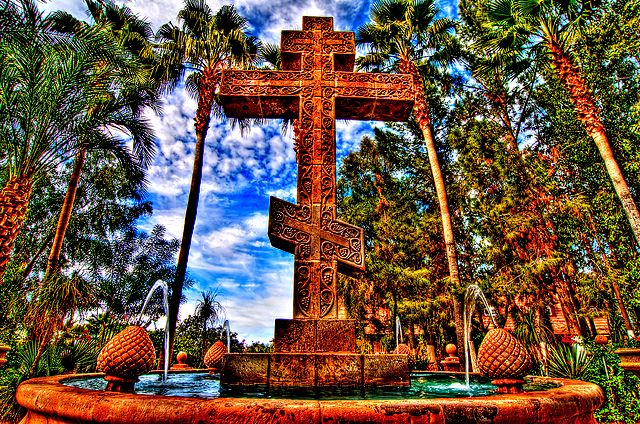
 Saint Anthony's Greek Orthodox Monastery - garden fountain - Florence, Arizona.


The symbol of the cross is ubiquitous in society. It is printed on bumper stickers and tattooed on forearms; it is spray painted on concrete walls and stitched onto denim jackets; it adorns the necks of gangsta rappers as well as scantily clad models. Is the cross merely a fashion statement, a cultural icon, a religious trademark, or is it something more?

             The cross is the third most celebrated subject in the Orthodox Church calender—the first two being the life of our Lord and the life of the Theotokos. The cross is commemorated on the feast day of the Exaltation of the Holy Cross (14 September), on the feast day of the Veneration of the Holy Cross (the third Sunday in Lent), and in the Thursday evening into Great Friday services during Holy Week. The cross receives so much attention because it is crucial for your understanding of the Christian faith. The word “crucial”—meaning decisive, critical, essential—comes from the Latin crux, from which we derive our English word “cross.”  In other words, the most important event in history is what happened on the cross where Jesus Christ was executed. That act is at the root of salvation and is the basis for Christian theology.  “Take therefore first, as an indestructible foundation, the cross, and build upon it the other articles of the faith” (St. Cyril of Jerusalem).


Reconciliation


            There are many events in the Old Testament that foreshadow the cross: the blood of a lamb placed on lintels and doorposts during Passover (Exodus 12:23); Moses lifting his staff and parting the Red Sea (Exodus14:16); Moses’ outstretched arms in prayer for victory over Israel’s enemies (Exodus 17:8-15); and Israel being saved from poisoning by looking at a bronze serpent on a pole (Numbers 21:6-9). There are also prophetic allusions to the cross: the curse of being hung on a tree (Deuteronomy 21:23); the predicted passion of the Messiah (Psalm 22); the saving mark on the forehead (Exekiel 9:3-6, LXX; cf. Revelations 7:2-4; 22:4); and the blood that drips from wood (2 Esdras 5:5). These references attest that the cross was always part of God’s plan for salvation.

            God reconciles His people by delivering us from the consequences of sin, and the means God uses to rescue us is the cross. Isaiah stated that the Messiah, “poured out his life unto death and was numbered with the transgressors. For he bore the sin of many, and made intercession for the transgressors” (Isaiah 53:12). The Apostle Paul confirmed this prophecy when he wrote, “For God was pleased to have all his fullness dwell in [Christ], and through him to reconcile to himself all things, whether things on earth or things in heaven, by making peace through his blood, shed on the cross” (Colossians 1:19-20; see also 2:13-15). Therefore the cross represents God’s victory over sin:

“For the cross destroyed the enmity of God towards man, brought about reconciliation, made the earth heaven, associated men with angels, pulled down the citadel of death, unstrung the force of the devil, extinguished the power of sin, delivered the world from error, brought back the truth, expelled the demons, destroyed temples, implanted virtue, [and] rounded the churches” (St. John Chrysostom).

Saturday, 13 September 2014

A Miracle of the True Cross On Mount Athos!(Video)


The video above shows a monk from Mount Athos displaying a miracle of the True Cross. He places the splinter of the Holy Wood in a glass of water, which naturally floats, and following some prayers he places it in the water again and it sinks to the bottom.

He also displays a fragrant relic of St. Haralambos towards the end for veneration.


Ζωντανό Θαύμα στο Άγιον όρος με το Τίμιο ξύλο που βυθίζεται, κατόπιν προσευχής, δεν μπορεί να αμφισβητηθεί. Ένα Θαύμα που αξιζει όλοι να το δούν! 

Wednesday, 26 March 2014

True Peace is the Way of the Cross


Fr. Tryphon
In an age that seems to be forever witnessing wars between nations, and civil wars within nations, peace seems to be something that is about as possible as the alchemy that would turn metal into gold. Peacemakers struggle to find peaceful solutions for the conflicts between nations, political parties, religions, neighbors, and even within families. Peace is something we all hope for, but never seem to see in our lifetime. When peace comes to one part of the world, war breaks out in another part of the world. War seems to always have the upper hand, while peace seems only the dream of pacifists, dreamers, and poets.
In the nineteen-sixties, many had hoped peace was about to reign in our world, for pop philosophers and hippies thought they were ushering in a new age. In preparation for this Age of Aquarius, young people grew their hair long, wore flowers in their hair, and embraced a lifestyle that was to last forever. The musical Hair even touted the ideal, and a whole generation “tuned in, turned on, and dropped out”.
When the Soviet Union imploded, and with it we saw the end of the Cold War, many believed war would be no more. The West no longer had as an enemy, the Soviet Union.  It didn’t take long for all to realize peace was still beyond our grasp, and wars between nations and peoples was to continue. We were no longer at war with Communism, but with Islam, or other ideologies. So, peacemakers still struggle for the cause of peace, but on different fronts.
Peace is that evasive goal that still strikes hope in the hearts of men, however improbable its attainment may seem. We Christians have always had the acquisition of peace as a central theme in corporate prayers. The Liturgy of Saint John Chrysostom has petitions for peace throughout, and the first three litanies are petitions for peace. The priest even prays for “an angel of peace, and a guardian of our souls”. An Angel of Peace was assigned as our personal guardian angel, at the moment of our baptism.
Peace is such a central theme in the life of the Church that nineteenth century Russian Saint Seraphim of Sarov said, “Acquire peace and a thousand around you will be saved”. The personal acquisition of peace begins with repentance, that moment in time when we have a change of mind, and decide to follow the path to wholeness.
Peace is not just an idea, but an active force for change. When we pray in the Liturgy for “peace for the whole world”, we are praying not just for this world, but for the entire cosmos. We are praying for peace for people, peace for animals, peace for plants and rocks, peace for the sun and moon and stars. When praying for peace we realize that peace is a gift of grace from heaven, and this peace is beyond comprehension, for it is the peace of Christ.  It is “the peace of God, which surpasses all understanding (Philippians 4:7)”.
True peace is bound up in the sacrificial offering of Christ on the cross. Peace is interdependent with sacrifice. The services of the Church bring us into the atmosphere of peace, for this peace comes from God. Peace can enter the world only if it takes root in the hearts of humans, and this peace requires sacrifice. The transformation of the cosmos begins with you. Peace enters the universe when it takes root in your heart.

This article was posted on January 15, 2012 on The Morning Offering which can be found here:  http://morningoffering.blogspot.com/

Sunday, 23 March 2014

Elder Paisios -On Demons and the Power of the Cross

Elder Paisios The Athonite
 
 Elder Paisios was asked the following regarding demons (called "tagalakia" by some Greeks) and the power of the Cross:
 
- Elder, my thoughts tell me that the devil, especially nowadays, has a lot of power.

- The devil has evil and hatred, not power. The love of God is all-powerful. Satan tries to appear all-powerful, but he does not succeed. He seems strong, but he is completely weak. Many of his destructive plans are spoiled before they even begin to be manifested. Would a very good father allow some punks to hit his children?

- Elder, I'm afraid of tagalakia(Demons).

- What is there to fear? Tagalakia have no power. Christ is all-powerful. Temptation is rotten to the core. Don't you wear a Cross? The devil's weapons are weak. Christ has armed us with His Cross. Only when we discard our spiritual weapons, then the enemy has power. An Orthodox priest showed a small Cross to a magician, which made the demon he invoked through his magic tremble.

- Why is he so afraid of the Cross?

- Because when Christ accepted the beatings, the slaps and the blows, the kingdom and power of the devil was crushed. By which way did Christ conquer? "With the rod the rule of the devil was crushed," says a Saint. That is, with the last blow of the rod to His head, then the power of the devil was crushed. Patience is the spiritual defense and humility is the greatest weapon against the devil. The greatest balm of Christ's sacrifice on the Cross is that the devil was crushed. After the Crucifixion of Christ he is like a snake with its poison removed or a dog with its teeth removed. The poison of the devil has been removed, the teeth of the dogs, the demons, have been removed, and now that they are disarmed we are armed with the Cross. The demons can do nothing, nothing, to those who have been formed by God when we do not give them the right. They only cause a commotion because they have no power.

One time I was in the Cell of the Honorable Cross, and I had a very beautiful vigil. During the night many demons had collected on the ceiling. At first they were beating heavy and making noise, as if they were dragging large tree trunks.  I made the sign of the Cross towards the ceiling and chanted: "We venerate Your Cross Master...." When I finished, the dragging of the logs continued. "Now," I said, "we will form two choirs. In one you will do the dragging above and I will do the other below." When I began, they stopped. First I chanted "We venerate Your Cross...", then "Lord, Your Cross you gave to us as a weapon against the devil...." I had the most pleasant night chanting and, when I stopped for a bit, they continued the entertainment! Every time they present a different work.

- When you chanted the first time, they didn't leave?

- No. Once I was done, they began. Yes, both choirs had to complete the vigil! It was a beautiful vigil! I chanted with longing! I had good days!

- Elder, what does the devil look like?

- You know how "beautiful" he is? Something else! If only you could see him! And how the love of God does not allow people to see the devil! O, the majority would die from their fear! Imagine if they saw him act, if they saw the "sweetness" of his form! Again, some would be greatly entertained. You know what kind of entertainment? How do they call it? Cinema? For anyone to see such work, they would have to pay a lot of money, but even then they would not be able to see him.

- Does he have a horn, a tail?

- Yes, all the accessories.

- Elder, did the demons become so ugly when they fell and the angels became demons?

- Well, of course! Even now it's as if lightning struck them. If lightning strikes a tree, will not the tree immediately become a black stump? They are the same way, as if they've been struck by lighting. At one time I told the tagalakia: "Come so I can see you, that I may not fall into your hands. Now that I am looking at you, your appearance shows how evil you are. If I fall into your hands, what evil I will suffer!"
 
Source-proskynitis.blogspot.gr


Friday, 21 March 2014

On the three components of the Life-Giving Cross and our own cross.

  
The great spiritual instructor in faith, Saint Theophanus the Recluse, said that the Cross of Christ was threefold. The cross which each Christian must bear in his life is also threefold, similar to the Life-giving Cross which, according to prophecy, was composed of three tree varieties (cypress, pine and cedar). Thus, in bearing our own cross, we see three sides to it, three crosses which merge into one.

The first of these crosses is the cross of fallen mankind. This cross was described briefly but accurately and powerfully by the Apostle Paul, who said of himself: “I know not what I do: the good which I wish to do - I do not; the evil which I do not wish to do - I do.” And man is a captive of his sin - this is the sin of fallen mankind from which no one can escape, and of which the same Saint Theophanus said: “Imagine a man who has a rotting and foul-smelling corpse firmly attached to his back: wherever he goes, wherever he runs, he is unable to escape from this horrible foul decay. It follows him persistently, pursues him relentlessly.”

The second cross is the one which we usually understand as being our own cross: this is the combination of all the sorrows, all the misfortunes, all the difficulties of which our lives are composed. This, precisely, is what is meant by bearing one’s cross. But that is not yet all.

The holy fathers say: here is a man surrounded by affliction, illness, misfortune. As soon as he gives himself up completely into the will of God, saying that the Lord does everything well and, therefore, whatever may be sent to him on this path of the cross, he accepts it all as being good - as soon as he says this in his heart (says Saint Theophanus) - everything will disappear as if by magic. Everything around him remains the same: the same afflictions, the same worries, but it is he who has changed and sees everything differently. Thus must a man have the firm conviction that the Heavenly Father will not give him a stone in place of bread.

If God sends us difficulties, that means they are needed and are to our benefit. The elder Ambrose of Optina said: “Whatever will be, will be, and what will be, will be whatever God gives us, and God gives us everything for our good.”

The last component of our cross is such that Saint Theophanus spoke of it with his usual deep humility. He said: “That cross is known only to those who have attained a high spiritual level. Such a person has already overcome all temptations, has easily overcome all difficulties. But there are higher temptations - the temptations of pride, the temptations of vainglory, the temptation to consider oneself, through one’s spiritual labors, as being better and higher than others. This cross is the heaviest to bear and is known only to those who, albeit with great difficulty, have overcome it.”

Saint Theophanus says that each Christian must be a cross-bearer. The life of each Christian begins with a cross: he is baptized and a cross is placed around his neck at the very moment of his entering the bright sacrament of baptism. When he is buried, the cross remains with him, and a cross is also placed over his grave, indicating that a faithful Christian is buried there.

Let us keep that in mind, my beloved, and let us always wear a cross, which strengthens us and saves us in difficult circumstances. Do not forget, Christian soul, of the strength of the cross, and that with the power of His Cross the Lord will always save you from all possible misfortune. Amen.
Metropolitan Philaret (Voznesensky).

Thursday, 21 November 2013

The Sacred Icons and the Holy Cross


God is the unique Being, the absolute existence; nothing can be compared with Him and the honor which is due Him, i.e. worship and adoration, is rendered unto none other; neither to some non-existent god nor to some idol.
But God's grace is transmitted in every way in accordance with His will; even through material objects or even through the shadow of holy men, as was the case with the shadow of the Apostles, which is their imprint, a type of image (Acts 5, 12-16. 19,11-12).
In the Old Testament some of the objects which transmitted the miraculous grace of God were the bronze snake of Moses, the Ark of the Covenant, the sheep-skin coat of the Prophet Elias, et al. Every desecration of the sacred objects was severely punished by God (see Num. 10,15-20. I Kings 5, 2-4).
The teaching of the Orthodox Church concerning the holy icons has a Christological foundation. God is by essence unapproachable; He can neither be expressed by words nor depicted. The Son and Word of God, how­ever, became man and we beheld His glory (Jn 1, 14). Thus we can depict the person of Christ which consti­tutes the visible sign of the invisible presence of God, an "image of the invisible God" (Col. 1, 15). In the Ortho­dox Church that which is seen can be depicted; we express the same confession of faith either by written or oral word and even by depiction. The icon of Christ constitutes the confirmation of the incarnation of the Son and Word of God, which was a totally real, and not a docetic or imaginary, one.
Through the sacred icons we express our internal desire to grow in the love of Christ and the saints, to attain to the "new creation in Christ" and to become "conformed to His image" (Rom. 8,29). Just as the word sanctifies our lips, in a like way the icon, which trans­mits the same meaning as does the word, sanctifies our eyes and our mind.
The icons of the saints refer to "the new man" and are a declaration of our belief in our transformation in Christ and in the incorruption of man and the entire world. They do not refer to the "beauty" of this world, but rather symbolize the beauty and the glory of the "future age". This is why the holy icons lack the dimen­sion of "depth" and are two-dimensional. They proclaim a transfigured world which however we observe "as through a mirror" (I Cor. 13, 12). The holy icons give us the feeling that there exists a new world that is being transformed, and they constitute the assurance of our hope, expressed in the words of our Lord: "Behold I make all things new" (Rev. 21,5).
The honor rendered to the holy icons is placed within the framework established by the Seventh Ecu­menical Council. According to the Holy Fathers of this council, the honor shown towards the holy icons refers back to the ancient Church and confirms the belief in the real incarnation of God the Word. This council ordains that along with the Holy Cross icons be made for the Churches, to be placed on the sacred vessels and the vestments of the priests, in the homes and in the roads; icons of Christ, the Theotokos and all the saints. It further underlines:
"For the more frequently they [the sacred icons] are seen, all the more those who see them are moved to remembrance and desire of those depicted; to them [the icons] they render greetings and a veneration of honor, but not true worship, which in accordance with our faith, is due only unto the divine nature...for the honor rendered to the icon is transfered to the prototype, and he who venerates the icon venerates the person depicted thereon".
Orthodox Christians believe that the Holy Cross is their only pride (Gal. 6,14). It is the instrument through which sin, the source of death, was set at naught (Rom. 5,12. 8,3). The Cross is thus no longer a symbol of death and of shame (Deut. 21,23), but a source of eternal life. Through the Cross the curse is done away with, conciliation "in Christ" is brought about, and "the new man" is created (Eph. 2, 15- 16). These truths are expressed in many of the hymns of the Church:
"You spread out Your hands on the Cross, Ο Merciful One, and You gathered together the Nations that were far from You so that they might glorify Your great goodness".
"By spreading out Your divine hands upon the Cross, Ο Jesus,
You brought unto Yourself the work of Your hands, and You freed all from the hands of the Evil One and subjected them [unto You], for which cause let us faithful hymn Your majesty, for indeed it is glorified".
The Cross of Christ is thus characterized by the Lord Himself as glory, as the judgment of this world, as the casting out of the Devil and as exaltation (Jn 12, 24-33). Our Church characterizes the Cross as "a weapon against the Devil", because he trembles and shudders at the sight of the Cross, not being able to bear its power.
"Lord, You have given us Your Cross as a weapon against the Devil; for he shudders and trembles, not being able to gaze upon its might.
For its resurrects the dead,
and abrogated death;
for which cause we venerate
Your entombment and Your Resurrection".
The Holy Cross of Christ becomes a standard and a measure of either man's triumph or his condemnation, depending upon the position he takes vis-a-vis it. Who­ever equates Christ's Cross with that of the thieves, is equated with the unrepentant thief and is condemned. On the contrary, whoever differentiates the Cross of Christ and considers it to be a royal scepter, and invokes the mercy of Christ, is likened unto the good thief, and the road leading to Paradise is opened up before him. In this way the Holy Cross becomes the measure of the judg­ment of the world, "the scale of justice" as it is called by the hymn of the Church:
"Your Cross stood between two thieves
as a scale of justice.
The one is led down to hell
by the weight of his blasphemy,
the other is lightened from the burden of his sins
unto the knowledge of things divine.
Ο Christ-God, glory to You".
When we speak of the Holy Cross we do not mean only Christ's crucifixion, but also the wood of the Cross. For this, too, is sanctified by its contact with the Body of Christ, and that is why it, too, is venerated: "The wood of Your Cross do we venerate, Ο Lover of man, for on it was nailed the Life of all things", states one of the Church's hymns. The sign of the Cross is also "divine and venerable", says St. Gregory Palamas, for it is "a venerable seal, sanctifying and perfecting all the marvelous and ineffable good things that come from God". It is an image of the crucified Christ and it draws its power and grace from His passion. This is why the sealing with the sign of the Cross is the external sign of all of the Church's Mysteries through which man's salvation is wrought.
The Cross of Christ expresses the ineffable love of God, but at the same time it also expresses man's infinite value in God's sight. A contemporary theologian says that Christ put sin to death without slaying the sinner; He did away with guilt and yet saved the guilty one. This is the great difference between Christ and human justice which crushes guilt by deriding and disgracing the guilty one. However, Christ did not simply conquer sin but also the consequence of sin which is death, and restored man to his pristine purity. Thus He led man to a surpassing of death, to the life of immortality and incorruption. Thus we do not have here a lifting of some type of Augustinian inherited guilt, nor room for any type of "payment" or "ransom" - save only in the patristic sense - and certainly not an Ansel-mian satisfaction of Divine justice. Rather the weight rests on Christ's love, Who achieved the most extreme limits of sacrifice in behalf of those whom He loves. And it is in precisely this that we see man's infinite value.
Making the sign of the Cross is an early Christian Tradition testified to by St. Justin the Martyr (+ 150) and by Tertullian (+ 200). The latter writes: " We Christians in all our travels and in all our movements about, at every departure and upon every arrival, when we put on our clothes and shoes, in the bath and at the table, when we light our lamp, when we sit or sleep, in all the acts of our every-day life in general, we make the sign of the Cross".
" This custom," Tertullian concludes, "has its beginnings in the Church's Tradition, it is strengthened through habit and should be preserved in faith".
Orthodox Christians unite the three fingers of their right hand and place them first on their forehead, then on their stomach and finally bring them to their two shoulders from right to left. All of the Church's theology is depicted in the sign of the Cross. By uniting our three fingers we depict and confess our belief in the One Triune God. From the forehead we bring our fingers to the stomach, and by so doing "typify the Son" Who was pre-eternally born of the Father and came down to earth by His birth from the Virgin Mary. When we place our united fingers on our shoulders we do so to "typify the Holy Spirit", Who is characterized as being the "arm" and the "might" of God. By uniting the remaining two fingers we depict Christ's incarnation and the inseparable union of the two natures, through which human nature was cured and exalted to the height of theosis.
We must not make the sign of the Cross in a mech­anical way, but conscientiously, with inner participation. We should make the sign of the Cross upon our bodies distinctly and not carelessly, but in accordance with the order of the Church: with our three fingers joined together and as if the Cross itself were touching us. It is understood that the sign of the Cross must be accom­panied by analogous faith in that which it depicts and b> the unwavering decision to crucify and do away with our sinful selves and our passions; to put on the new man and ever be orientated towards the Cross and the Resur­rection of Christ.
Orthodox Christians therefore render respect and honorary veneration to the Cross just as they do to the holy icons, in relation always to the personage of Christ. This also holds true for the honor rendered to the saints. This honor is not adoration and worship, but an express­ion of respect and love towards persons and things which God Himself honored by abundantly bestowing upon them His grace. This veneration would be transformed into worship only in such case where one were to render it by identifying in his conscience that which he vener­ated with God. No Orthodox Christian, however, ever identifies the Holy Cross, the sacred icons or the saints with God, nor does he differentiate the honor accorded them from their relationship to the person of our Lord.

DECEMBER 27, 2010

Friday, 5 April 2013

St. Ignatius Brianchaninov-On Carrying Your Cross

 Homily on the Third Sunday of Great Lent.
On Carrying Your Cross

 Whosoever will come after me, let him deny himself, and take up his cross, and follow me (Mk. 8:34)

Dear brothers and sisters! We too are disciples of our Lord Jesus Christ, because we are Christians. We too are called unto the Lord, to this holy temple, to hear His teaching. We stand before the face of the Lord. His gaze is directed at us. Our souls are laid bare before Him; our secret thoughts and hidden feelings are open to Him. He sees all of our intentions; He sees the truth, and the sins we have committed from our youth; He sees our whole life, past and future; even what we have not yet done is already written in His book.[1] He knows the hour of our passing into immeasurable eternity, and gives us His all-holy commandment for our salvation: Whosoever will come after me, let him deny himself, and take up his cross, and follow me.
Through living faith, let us lift up the eyes of our mind to the Lord Who is present here with us! Let us open our hearts, rolling back the heavy stone of hardness from its entrance; let us hear, ponder, accept, and assimilate the teaching of our Lord.
What does it mean to deny ourselves? It means leaving our sinful life. Sin, through which our fall occurred, has so encompassed our nature that it has become as if natural; thus, denial of sin has become denial of nature, and denying nature is denying ourselves. The eternal death that has struck our souls has become like life for us. It demands food: sin; it demands to be pleased—with sin. By means of such food and pleasure, eternal death upholds and preserves its dominion over man. But fallen man accepts the growth of the dominion of death in himself as growth and success in life. Thus, he who is infected with a fatal disease is overcome by the forceful demands of this disease and looks for foods that would strengthen him. He seeks them as the most essential foods, as the most needed and pleasant delights. The Lord pronounced His sentence against this eternal death, which mankind, sick with terrible fallenness, imagines to be life: For whosoever will save his life, cultivating in it the life of fallenness or eternal death, shall lose it; but whosoever shall lose his life for my sake and the gospel’s, the same shall save it (Mk. 8:35). Placing before our eyes the whole world with all its beauty and charm, the Lord says, For what shall it profit a man, if he shall gain the whole world, and lose his own soul? What good is it for man, what has he really acquired if he should come to possess not only some minor thing, but even the entire visible world? This visible world is no more than man’s temporary guesthouse! There is no item on the earth, not a single acquirable good that we could call our own. Everything will be taken from us by merciless and inevitable death; and unforeseen circumstances and changes often take them away even before our death. Even our own bodies are cast aside at that sacred step into eternity. Our possession and treasure is our soul, and our soul alone. What shall a man give in exchange for his soul? (Mk. 8:37), sayeth the word of God. There is nothing that can recompense the loss of the soul when it is killed by eternal death, which deceitfully calls itself life.
What does it mean to take up our cross? The cross was an instrument of shameful execution of commoners and captives deprived of a citizen’s rights. The proud world, a world at enmity with Christ, deprives Christ’s disciples of the rights enjoyed by the sons of this world. If ye were of the world, the world would love his own: but because ye are not of the world, but I have chosen you out of the world, therefore the world hateth you. Whosoever killeth you will think that he doeth God service. And these things will they do unto you, because they have not known the Father, nor me (Jn. 15:19; 16:2–3). Taking up our cross means magnanimously enduring the mocking and derision that the world pours out upon followers of Christ—those sorrows and persecutions with which the sin-loving and blind world persecutes those who follow Christ. For this is thankworthy, says the Apostle Peter, if a man for conscience toward God endure grief, suffering wrongfully. For even hereunto were ye called (1 Pet. 2:19, 21). We were called by the Lord, Who said to his beloved ones, In the world ye shall have tribulation: but be of good cheer; I have overcome the world (Jn. 16:33).
Taking up our cross means courageously enduring difficult unseen labor, agony, and torment for the sake of the Gospels as we war with our own passions, with the sin that lives in us, with the spirits of evil who vehemently make war against us and franticly attack us when we resolve to cast off the yoke of sin, and submit ourselves to the yoke of Christ. For we wrestle not against flesh and blood, says the holy Apostle Paul, but against principalities, against powers, against the rulers of the darkness of this world, against spiritual wickedness in high places (Eph. 6:12). (For the weapons of our warfare are not carnal, but mighty through God to the pulling down of strong holds;) Casting down imaginations, and every high thing that exalteth itself against the knowledge of God, and bringing into captivity every thought to the obedience of Christ (2 Cor. 10:4–5). After gaining victory in this unseen but laborious warfare, the Apostle exclaimed, But God forbid that I should glory, save in the cross of our Lord Jesus Christ, by whom the world is crucified unto me, and I unto the world (Gal. 6:14).
Taking up our cross means obediently and humbly submitting ourselves to those temporary sorrows and afflictions that Divine Providence sees fit to allow against us for the cleansing away of our sins. Then the cross will serve us as a ladder from earth to heaven. The thief in the Gospels who ascended this ladder ascended from out of terrible crimes into most radiant heavenly habitations. From his cross he pronounced words filled with humility of wisdom; in humility of wisdom he entered into the knowledge of God, and through the knowledge of God, he acquired heaven. We receive the due reward of our deeds, he said. Lord, remember me when thou comest into thy kingdom (Lk. 23:41–42). When sorrows encompass us, let us also, beloved brothers and sisters, repeat the words of the good thief—words that can purchase paradise! Or like Job, let us bless the Lord who punishes us, Who is just yet merciful. Shall we receive good at the hand of God, said this sufferer, and shall we not receive evil? As it hath pleased the Lord so is it done; blessed be the name of the Lord (Job 2:10; 1:21). May God’s promise, which is true, be fulfilled in us: Blessed is the man that endureth temptation: for when he is tried, he shall receive the crown of life, which the Lord hath promised to them that love him. (Js. 1:12).
Taking up our cross means willingly and eagerly submitting ourselves to deprivations and ascetic labors, by which the irrational strivings of our flesh are held in check. The Apostle Paul had recourse to such a crucifixion of his flesh. He says, But I keep under [in Slavonic: “deaden,” or “mortify”] my body, and bring it into subjection: lest that by any means, when I have preached to others, I myself should be a castaway (1 Cor. 9:27). They that are in the flesh, that is, those who do not restrain their flesh, but allow it to overcome the spirit, cannot please God (Rom. 8:8). Therefore, though we live in the flesh, we should not live for the flesh! For if ye live after the flesh, ye shall die (Rom. 8:12) an eternal death; but if ye through the Spirit do mortify the deeds of the body, ye shall live (Rom. 8:13) an eternal, blessed life. The flesh is essentially restrained by the spirit; but the spirit can only take control of the flesh and rule it when it is prepared to submit to its crucifixion. The flesh is crucified by fasting, vigil, kneeling in prayer, and other bodily labors placed upon it wisely and within measure. A bodily labor that is wise and within measure frees the body from heaviness and corpulence, refines its strength, keeps it ever light and capable of activity. They that are Christ’s, says the Apostle, have crucified the flesh with the affections and lusts (Gal. 5:24).
What does it mean to take up our cross, and take up specifically our own cross? It means that every Christian should patiently bear those very insults and persecutions from the world that come to him, and not any others. This means that every Christian should manfully and constantly war with those very passions and sinful thoughts that arise in him. It means that every Christian should with obedience and dedication to God’s will, with confession of God’s justice and mercy, with thankfulness to God, endure those very sorrows and deprivations that Divine Providence allows to come upon him, and not some other things painted and presented to him by his proud dreams. This means being satisfied with those bodily labors that correspond to our physical strength, the ones that our flesh require in order to keep it in order, and not to seek after increased fasting and vigil, or all other ascetic feats beyond our measure, which destroy our physical health and direct our spirit towards high self-opinion and self deceit, as St. John Climacus describes.[2] All mankind labors and suffers upon the earth, but these sufferings differ; the passions differ that war against us, the sorrows and temptations differ that God sends us for our healing, for the cleansing away of our sins. What differences there are in people’s physical strength, in their very health! Precisely: every person has his own cross. And each Christian is commanded to accept this cross of his own with self-denial, and to follow Christ. He who has denied himself and taken up his own cross has made peace with himself and with his own circumstances, with his own position both internal and external; and only he can reasonably and correctly follow Christ.
What does it mean to follow Christ? It means studying the Gospels, having the Gospels as the only guide of the activity of our mind, heart, and body. It means adapting our thoughts to the Gospels, tuning the feelings of our heart to the Gospels, and serving as an expression of the Gospels by all our deeds and movements, both secret and open. As we said before, only the person who has escaped deceit through voluntary humility (Col. 2:18), who has desired to obtain true humility of wisdom where it abides—in obedience and submission to God—is capable of following Christ. He who has entered into submission to God, into obedience combined with complete self-denial, has taken up his own cross, and accepted and confessed this cross to be his own.
Beloved brothers and sisters! Bowing down bodily to worship the precious Cross of the Lord today according to the rule of the Holy Church, we bow down also in spirit! We venerate the precious Cross of Christ—our weapon of victory and banner of Christ’s glory—each confessing from his own cross, “I have received the due reward of my deeds! Remember me, O Lord, when Thou comest into Thy Kingdom!” By recognizing our sinfulness with thankfulness to God and submission to His will, we make our cross—that instrument of execution and mark of dishonor—an instrument of victory and sign of glory, like unto the Cross of the Lord. Through the cross we open paradise to ourselves. Let us not allow ourselves any evil murmuring, and especially not any soul-destroying blasphemy, which is often heard from the lips of the blind and hardened sinner, who writhes and thrashes upon his cross, vainly endeavoring to escape from it. With murmuring and blasphemy the cross becomes unbearably heavy, dragging to hell the one crucified upon it. “What have I done?” cries the sinner in denial of his sinfulness, accusing the just and merciful God of injustice and mercilessness, blaming and rejecting God’s Providence. The one who saw the Son of God crucified, mockingly and evilly demanded of him, If thou be Christ, save thyself and us (Lk. 23:39),—let him now come down from the cross (Mt. 27:42). But our Lord Jesus Christ was pleased to ascend the Cross in the flesh and to endure death[3] in order by the cross to make peace between God and man, and to save mankind by death from eternal death. Having prepared the holy Apostles for this great event—the incarnate God-man’s sufferings and shameful death, potent to redeem the human race—the Lord informed the Apostles in good time that He must be given over into the hands of sinners, must suffer much, be killed, and resurrected. This forewarning seemed strange and unlikely to certain of the holy Apostles. Then the Lord called unto Him his disciples and said to them: Whosoever will come after me, let him deny himself, and take up his cross, and follow me. Amen.
St. Ignatius (Brianchaninov)
Translated by Nun Cornelia (Rees)
 
[1] St. Symeon the New Theologian, according to the book written in verse, homily 55.
[2] The Ladder of Divine Ascent, homily 26.
[3] Troparion to the Resurrection, tone 5.

Thursday, 4 April 2013

St Gregory Palamas on the Third Sunday of Lent: the Holy Cross

 Saint Gregory Palamas

The Cross of Christ was mysteriously proclaimed in advance and foreshadowed from generations of old and no one was ever reconciled with God except by the power of the Cross. After our First Parents transgressed against God through the tree in paradise, sin came to life, but we died, submitting, even before physical death, to the death of the soul, its separation from God. After the transgression we lived in sin and according to the flesh. Sin “is not subject to the law of God, neither indeed can be. So then they that are in the flesh cannot please God” (Romans 8.7-8).
As the apostle says, “The flesh lusteth against the Spirit, and the Spirit against the flesh” (Galatians 5.17). God, however, is Spirit, absolute Goodness and Virtue, and our own spirit is after His image and likeness, although sin has made it good for nothing. So how could anyone at all be spiritually renewed and reconciled with God, unless sin and life according to the flesh had been abolished? The Cross of Christ is this abolition of sin. One of our God-bearing Fathers was asked by an unbeliever if he really believed in Christ crucified. “Yes”, he replied, “I believe in Him who crucified sin.” God Himself has borne witness that there were many who were His friends before and after the law, when the Cross had not yet been revealed. David, the king and prophet, says, as if there were definitely friends of God in his day, “How precious also are thy friends unto me, O God!” (Psalm 139.17 LXX). I shall now show you, if you listen attentively for the love of God, how it was that people were called friends of God before the Cross.
Although the man of sin, the son of lawlessness (2 Thessalonians 2.3), by which I mean the Antichrist, has not yet come, the theologian whom Christ loved says, “Even now, Beloved, there is antichrist” (1 John 2.18). In the same way, the Cross existed in the time of our ancestors, even before it was accomplished. The great Paul teaches us absolutely clearly that Antichrist is among us, even though he has not yet come, saying, “His mystery doth already work in you” (2 Thessalonians 2.7). In exactly the same way Christ’s Cross was among our forefathers before it came into being, because its mystery was working in them.
Leaving aside Abel, Seth, Enos, Enoch, Noah, and all those up until Noah who were pleasing to God, and their contemporaries, I shall begin with Abraham, who was called the father of many nations, the Jews’ father after the flesh and ours by faith. As I am to start with this spiritual father of ours, his good beginning and God’s initial call to him, what were the first words God spoke to him? “Get thee out of thy country, and from thy kindred, unto a land that I will show thee” (Genesis 12.1). This utterance certainly bears within it the mystery of the Cross, for it is exactly what Paul says when he glories in the Cross: “The world is crucified unto me” (Galatians 6.14). When someone had fled his home country or the world without turning back, for him his country according to the flesh and the world have been put to death and ceased to exist, and this is the Cross.
God said to Abraham, before he had fled from his life with ungodly men, “Get thee out of thy country unto a land”, not, that I will give thee, but “that I will show thee” (Genesis 12.1), so that through this land another, spiritual land might be shown. What were God’s first words to Moses once he had fled from Egypt and ascended the mountain? “Put off thy shoes from off thy feet” (Exodus 3.5). This is another mystery of the Cross which follows appropriately upon the first. “You have come out of Egypt”, says God, “you have left the service of Pharaoh, and have despised the fact that you were called the son of Pharaoh’s daughter. That world of evil servitude has been dissolved and ceased to exist, as far as you are concerned. Nevertheless you still need something more.” What can that be? “To take your shoes from off your feet, to lay aside the coats of skin (Genesis 3.21) with which sin clothed you and in which it is at work, separating you from the holy ground. Take these shoes from your feet”, which is to say, “do not live any longer according to the flesh and in sin, but let that life which is opposed to God be abolished and put to death. And let the way of thinking based on the flesh (Romans 8.6-7), and the law in your members warring against the law of your mind, and bringing you into captivity to the law of sin (Romans 7.23-8.2), no longer hold sway, nor be active, for it has been put to death by the power of this vision of God.” Surely this is the Cross. In the divine Paul’s words, the Cross is to have crucified “the flesh with the afflictions and lusts” (Galatians 5.24).
“Put off”, He says, “thy shoes from off thy feet” (Exodus 3.5). These words to Moses revealed that the earth was to be hallowed through the Cross after the manifestation of our Lord and God and Saviour Jesus Christ. At that time, as he looked at that great spectacle of the burning bush which seemed cool as the dew, Moses foresaw the coming of Christ, which was then in the future. The vision in God of the Cross is a mystery greater than that earlier mystery. The great Paul and our holy Fathers hint that there are two mysteries. For Paul not only says, “The world is crucified unto me”, but adds, “and I to the world” (Galatians 6.14). The Fathers, for their part, command us not to hasten to ascend the cross before the Cross, as though there were definitely two words of the Cross and two mysteries.
The first mystery of the Cross is flight from the world, and parting from our relatives according to the flesh, if they are a hindrance to piety and a devout life, and training our body, which Paul tells us is of some value (1 Timothy 4.8). In these ways the world and sin are crucified to us, once we have fled from them. According to the second mystery of the Cross, however, we are crucified to the world and the passions, once they have fled from us. It is not of course possible for them to leave us completely and not be at work in our thoughts, unless we attain to contemplation of God. When, through action, we approach contemplation and cultivate and cleanse our inner man, searching for the divine treasure which we ourselves have hidden, and considering the kingdom of God within us, then it is that we crucify ourselves to the world and the passions. Through meditation of this a certain warmth is born in our heart, which cleanses away evil thoughts like flies, instills spiritual peace and consolation in our soul, and bestows sanctification on our body. As the psalmist says, “My heart was hot within me, while I was musing the fire burned” (Psalm 39.3). One of our God-bearing Fathers taught us about this, saying, “Strive as hard as you can to ensure that your inner labour is according to God’s will, and you will conquer the outward passions.” The great Paul, urging us on in the same direction, says, “Walk in the Spirit, and ye shall not fulfil the lusts of the flesh” (Galatians 5.16). Elsewhere he exhorts, “Stand therefore, having your loins firt about with truth” (Ephesians 6.14). For the contemplative part of the soul strengthens and supports the part concerned with desires, and chases away fleshly lusts. The great Peter tells us with absolute clarity what the references to the loins and the truth mean. “Wherefore”, he says, “gird up the loins of your mind, be sober, and hope to the end for the grace that is to be brought unto you at the revelation of Jesus Christ” (1 Peter 1.13).
Since it is not possible for the evil passions and the world to leave us completely and not be at work in our thoughts, unless we attain to contemplation of God, inasmuch as such contemplation is also the mystery of the Cross, which crucifies those who are worthy of it to the world. That vision which Moses had of the burning bush not consumed by the fire, was also a mystery of the Cross, greater and more perfect than the mystery in the time of Abraham. Is is then the case that Moses was initiated into the more perfect mystery of the Cross, whereas Abraham was not? That would be unreasonable. In fact, Abraham was not initiated at the time when he was called, but afterwards he was, once, twice, and in fact many times, though we do not have enough time to relate everything now.
I shall remind you of Abraham’s most wonderful vision of God, when he clearly saw the one God in three persons, before He had been proclaimed to be such (Genesis 18.1-16). “The Lord appeared unto him by the oak of Mamre; and he lifted up his eyes and looked, and lo, three men stood by him: and he ran to meet them.” He actually saw the one God who appeared to him as three. “God appeared unto him”, it says, “and, lo, three men.” Having run to meet the three men, however, he addressed them as one, saying, “My Lord, if now I have found favour in thy sight, pass not away from thy servant.” The three then discourse with him as though they were one. “And he said unto Abraham, Where is Sarah thy wife? I will certainly return unto thee about this same time of year: and Sarah thy wife shall have a son.” As the aged Sarah laughed on hearing this, “the Lord said, Wherefore did Sarah laugh?” Notice that the one God is three hypostases, and the three hypostases are one Lord, for it says, “The Lord said”.
This is how the mystery of the Cross worked in Abraham. As for Isaac, he himself prefigured Him who was nailed to the Cross for, like Christ, he was obedient to his father unto death. The ram offered instead of him (Genesis 22.13) clearly foreshadowed the Lamb of God who was led to the slaughter for our sake. Even the thicket in which the ram was caught contained the mystery of the sign of the Cross, for it was called the thicket of “Sabek”, meaning the thicket of forgiveness (Genesis 22.13 LXX), just as the Cross was called the wood of salvation. In Isaac’s son, Jacob, the mystery and sign of the Cross were also at work, for he increased his flocks by means of wood and water (Genesis 30.37-43). The wood prefigured the wood of the Cross, an the water, holy baptism, which holds within it the mystery of the Cross. “We were baptized into Christ’s death”, says the apostle (Romans 6.3). Christ, too, increased His human flocks by means of wood and water, the Cross and baptism.
When Jacob bowed himself upon the end of his staff and blessed his grandchildren with his hand crossed (Genesis 48.9-20), he brought the sign of the Cross even more clearly to light. Because he was obedient to his forefathers from start to finish, he was beloved and blessed, even though Esau hated him for this. He bore every temptation with courage, and the mystery of the Cross was at work throughout his whole life. That is why God said, “Jacob have I loved, but Esau have I hated” (Romans 9.13 and Malachi 1.2-3). Something similar, brethren, happens in our case. When someone obeys his earthly and spiritual fathers in accordance with the apostolic commandment saying, “Children, obey your parents” (Ephesians 6.1), he is loved by God as having become in this respect like His beloved Son (Matthew 3.17; 17.5; Mark 1.11; 9.7; Luke 3.22; 9.35; 2 Peter 1.17). But the disobedient son is hateful to God because he is a stranger to any resemblance to His beloved Son. Solomon the wise man makes it clear that this does not just apply to Jacob and Esau, but to everyone at all times. “An obedient son”, he says, “is unto life: but the disobedient is unto destruction” (Proverbs 13.1 LXX).
Surely Jacob, the son of obedience, attained to the greater mystery of the Cross, by which I mean the vision of God through which a person is more perfectly crucified to sin, dies to it and lives to virtue? He actually bears witness himself to his vision and his salvation. “For I have seen God”, he says, “face to face, and my soul is saved” (Genesis 32.30 LXX). Where are the people who still go along with the loathsome prattle of those heretics who have appeared in our day? Let them hear that Jacob saw God’s face, and not only did he not lose his life but, as he says himself, he was also saved, even though God said, “There shall no man see me, and live” (Exodus 33.20). Surely there cannot be two Gods, one whose face can be seen by the saints, the other whose face is above vision. Perish the impious thought! The face of God visible at the time of His manifestation to those who are worthy is His energy and grace. Whereas His face which is never seen is what is sometimes called the nature of God, and is beyond the scope of any manifestation or vision. As it is written, “No one hath stood in the substance and essence of the Lord” (Jeremiah 23.18 LXX), and either seen God’s nature or made it known. So contemplation in God and the sacred mystery of the Cross do not just drive away evil passions, and the devils who devise them, from the soul, but also heretical doctrines. They refute the advocates of such ideas, and thrust them outside the boundaries of Christ’s Holy Church, within which we have the privelege now to celebrate and declare the grace and energy of the Cross among our Fathers in the time before the Cross.
The mystery of the Cross was working in Abraham, whereas his son Isaac himself prefigured the one who was afterwards crucified. In the same way, the mystery of the Cross was at work throughout Jacob’s life, while Jacob’s son Joseph was himself a type and mystery of the divine and human Word who was later crucified. Joseph was led to the slaughter through jealousy, by his kinsmen according to the flesh, for whose sake his father sent him, just as was later the case with Christ. We should not be surprised, however, that Joseph was not murdered but sold. Isaac was not killed either. These men prefigured the truth that was to come, but were not themselves this truth. We can, however, discern in them the twofold mystery of Christ’s twofold nature. Their being led to the slaughterr foreshadowed the passion according to the flesh of Him who was the God-man, whereas the fact that they did not suffer foretold the impassible nature of His divinity. It was the same with regard to Jacob and Abraham. Although they were tempted, they were victorious, which is what the Scriptures clearly tell us about Christ. Of these four men who were renowned for their virtue and devoutness in the time before the law, two, Abraham and Jacob, had the mystery of the Cross at work in their lives, whereas the other two, Isaac and Joseph, themselves proclaimed the mystery of the Cross beforehand in a marvellous way.
But what about Moses, who was the first to receive the law from God and to share it with others? He was himself saved by means of wood and water before the law was given, when he was exposed to the Nile’s currents, hidden away in an ark (Exodus 2.3-10). And by means of wood and water he saved the people of Israel, revealing the Cross by the wood, holy baptism by water. Paul, who had looked upon the mysteries, says openly, “They were all baptized into Moses in the cloud” (1 Corinthians 10.2). He also bears witness that, even before the events concerning the sea and his staff, Moses willingly endured Christ’s Cross, “Esteeming”, he says, “the reproach of Christ greater riches than the treasures of Egypt” (Hebrews 11.26). For the Cross is the reproach of Christ from the standpoint of foolish men. As Paul himself says of Christ, “He endured the Cross, despising the shame” (Hebrews 12.2). Far in advance, Moses proclaimed in the clearest possible way the figure and form of the Cross and the salvation this sign would bring. For he stood his staff upright and stretched out his hands above it and, when he had formed himself into the shape of a cross upon his staff, this sight completely routed Amalek (Exodus 17.8-13). Again, by placing the serpent of brass sideways upon a standard, he publicly raised up the sign of the Cross and commanded the Jews who had been bitten by serpents to look upon it as a means of salvation, and so he healed the serpents’ bites (Numbers 21.4-9).
Time fails me to tell of Joshua and his fellow judges and prophets, or David and his successors who, by the working of the mystery of the Cross within them, dried up rivers (2 Kings 19.24; Isaiah 37.25), made the sun stand still (Joshua 10.13), razed the cities of the ungodly (Genesis 19.25; 2 Peter 2.6), became mighty in war, put foreign armies to flight, escaped the edge of the sword, quenched the violence of fire, stopped the mouths of lions, put kings to shame (Hebrews 11.33-34; Judges 4.6; 13.24; Daniel 6.23; 3.23-25, 49-50), reduced captains of fifty to ashes (2 Kings 1.13), raised the dead (1 Kings 17.23; 2 Kings 4.36), made the heavens stand still with a word (2 Kings 20.10-11), then let them go, preventing the clouds from giving rain, then letting them do so. If Paul says that faith has done all these things (Hebrews 11.32-40), it is because faith is power unto salvation, and all things are possible for him who believes. Clearly the Cross has this same power for believers. “For the preaching of the Cross”, to quote Paul again, “is to them that perish foolishness, but unto us which are being saved it is the power of God” (1 Corinthians 1.18).
If we move on from all those who lived before or under the law, the Lord Himself, “for whom are all things, and by whom are all things” (Hebrews 2.10), said before the Cross, “He that taketh not his cross, and followeth after me, is not worthy of me” (Matthew 10.38). Notice that even before the Cross was fixed in the ground, it was the Cross which brought salvation. When the Lord spoke openly beforehand of His passion and death on the Cross, Peter could not bear to hear. Knowing the Lord’s power, he entreated Him, saying, “Be it far from thee, Lord: this shall not be unto thee” (Matthew 16.22). The Lord reprimanded him because in this respect his thinking was human not divine. And “when he had called the people unto him with his disciples also, he said unto them, Whosoever will come after me, let him deny himself, and take up his cross, and follow me. For whosoever will save his soul shall lose it; but whosoever shall lose his soul for my sake and the gospel’s, the same shall save it” (Mark 9.34-35; Luke 9.23; Matthew 16.24-25).
He also invited the people together with his disciples, and then announced and proclaimed these great and marvellous throughts which are obviously from God not from men. This was to make it clear that such things were not demanded solely of his chosen disciples, but of everyone who believes in Him. To follow Christ means to live according to His Gospel and to give proof of every virtue and of true piety. The fact that anyone wishing to follow Him must deny himself and take up his cross means he must not spare himself when the moment comes, but be ready to die a dishonourable death for the sake of virtue and the truth of holy doctrines. Though it be a great and marvellous thing for someone to deny himself and surrender himself to extreme dishonour and death, it is not contrary to reason. When earthly kings go to war, they do not let people follow them who are not prepared to die for them. So it is not surprising that the King of heaven, who came to live on earth according to His promise, should seek such people as His followers in His attack upon the common enemy of the human race. Earthly kings can neither revive those killed in war, nor reward them fittingly for bearing the brunt of the battle. What could someone who is no longer alive receive from them? But in the Lord there is hope even for those who have died, if their death was in defence of what is sacred. To His followers who were daring in battle the Lord gives the reward of eternal life.
Whereas earthly kings require those who follow them to be prepared to die for them, the Lord gave Himself over to death for our sake and commands us to be ready to die not for His sake, but for ours. To make it clear that it is for our own sake, he adds, “For whosoever will save his soul shall lose it; but whosoever shall lose his soul for my sake and the gospel’s, the same shall save it” (Mark 8.35). What does this mean, that anyone who wants to save it shall lose it, and anyone who loses it shall save it? Man is twofold, consisting of our outward man, the body, and our inward man, the soul. When our outward man gives himself over to death, he loses his soul, being separated from it. But when someone loses his soul for Christ and the Gospel, he clearly saves and gains it, because he has procured for it eternal life in heaven. In the resurrection he will recover it, and by means of it he will become, even in his body I say, just as heavenly and eternal as it is. Anyone, by contrast, who clings to life is not prepared to lose his soul in this way, because he loves this fleeting age and everything to do with it. He will inflict loss on his soul, depriving it of true life, and he will lose it, surrendering it along with himself, alas, to eternal punishment. The all-merciful Lord mourned for such people and indicated how great a disaster was theirs by saying, “For what shall it profit a man, if he shall gain the whole world, and lose his own soul? Or what shall a man give in exchange for his soul?” (Mark 8.36-37). For neither his glory nor any of the other deceptive honours and delights of this present age, chosen by him in preference to a death which brings salvation, will go down with him. How could any of these things be given in exchange for a human soul, which is worth more than the whole world?
Even if a man could gain the whole world, brethren, it would be of no benefit to him because he would have lost his own soul. In reality, each person can only acquire an infinitely small share of this world. What a disaster, then, if someone loses his soul in his efforts to acquire this tiny share, rather than choosing to take up the sign and word of the Cross and to follow the giver of life. Now both the sign which we reverence and the word concerning it are, in fact, the Cross.
As the word and the mystery came before the sign itself, we shall expound them to your charity first. Or rather, Paul expounded them before us, Paul who boasts in the Cross, determined not to know anything save the Lord Jesus, and Him crucified (1 Corinthians 2.2). What does he say? The Cross means crucifying the flesh with its passions and desires (Galatians 5.24). Do you think he is referring only to the passions of sensual pleasure and gluttony? In that case he would not have written to the Corinthians, “Since there is among you strife and divisions are ye not carnal and walk as men?” (1 Corinthians 3.3). Consequently, anyone who loves glory or money, or simply wants to impose his own will in his eagerness to prevail, is carnal and walks as men, since such things are the source of divisions. As James, the Lord’s brother, says, “From whence come wars and fightings among you? Come they not hence, even of your lusts that war in your members? Ye lust and have not: ye fight and war” (James 4.1-2). Crucifying the flesh with its passions and longings means stopping all activity which is displeasing to God. Although our body may pull us down and exert pressure on us, we must still lift it up urgently to the height of the Cross. What am I trying to say? When the Lord was on earth He lived a life of poverty, and not just lived but preached poverty, saying, “Whosoever he be of you that forsaketh not all that he hath, he cannot be my disciple” (Luke 14.33).
May none of you, brethren, be annoyed when you hear us announcing, in unadulterated form, the good and acceptable and perfect will of God, nor be vexed because you think these precepts are unattainable. Bear in mind, firtsly, that the kingdom of heaven is subject to violence, and the violent take it by force (Matthew 11.12). Listen to Peter, the leader of Christ’s apostles, who says, “Christ also suffered for us, leaving us an example, that we should follow his steps” (1 Peter 2.21). Then you should consider the fact that when someone really learns how much he owes the Master, and is unable to repay in full, he modestly offers as much as he can and freely chooses to. As for the remaining debt, he humbles himself before the Lord and, attracting His compassion through his humility, he makes up for the shortfall. If someone observes his thought reaching out towards riches and wealth, he must realize that this fleshly thought separates him from Christ crucified within him.
How can you begin to take this thought up to the height of the Cross? Having put your hope in Christ who provides for all creation and nurtures it, keep away from all unjust gains, and do not be too attached even to honest income. Put it to good use and let the poor share in it as much as possible. It is the same with the commandment to deny the body and take up our cross. Although godly people who live according to His will have bodies, they are not too attached to them, but make use of their assistance when necessary. Should the be called upon to do so, they are ready to part with them. If you act in this way i n respect of the body’s attributes and needs, even if you can do nothing more, this is good and pleasing to God. Do you see the thought of fornication forcefully stirred up within? Be aware that you have not yet crucified yourself. How can this be done? Flee from looking inquisitively at women, from unseemly familiarity with them and inappropriate conversation. Reduce the fuel with feeds this passion by giving up excessive drinking, drunkenness, eating your fill and sleeping too much. To the renunciation of these evils add humblemindedness, and call upon God with a contrite heart for help against this passion. Then you too will say, “I have seen the wicked in great power and filled up like the cedars of Lebanon. I passed him by through self-control and, lo, he was not: I sought him in humble prayer, but his place could not be found in me” (Psalm 36.35-36 LXX).
Are you troubled by the thought of the love of glory? When you are in meetings or councils, bring to mind the Lord’s advice on this subject in the Gospels. Do not try to appear superior to other when you speak. Practise any virtues you have in secret, looking only to God and seen only by Him, “and thy Father which seeth in secret shall reward thee openly” (Matthew 6.6). If, after cutting off the causes of every one of the passions, the thought of them still inwardly troubles you, do not be afraid. It will procure you crowns, since it annoys you but does not win you over, and is not active. It is a dead movement, conquered by your godly struggle.
Such is the word of the Cross (1 Corinthians 1.18). It was and is, therefore, a great and truly divine mystery, not only in the time of the prophets before it was accomplished, but also now after it has been fulfilled. Why is this so? On the face of it, anyone who lowers and humbles himself in all respects seems to be bringing dishonour on himself, anyone who flees carnal pleasures appears to be causing himself toil and grief, and anyone who gives away his possessions looks as though he is making himself poor. But by the power of God this poverty, grief and dishonour give birth to inexhaustible riches, inexpressible delight and eternal glory, both in this world and in the world to come. Paul ranks those who do not believe this, and prove their faith by their actions, with the lost, or with the Greeks. “We preach”, he says, “Christ crucified, unto the Jews a stumbling block”, because they do not believe in the saving passion, “and unto the Greeks foolishness”, as they value transitory things above all else because of their complete disbelief in God’s promises, “but unto them that are called, Christ the power of God and the wisdom of God” (1 Corinthians 1.23).
This is the wisdom and power of God: to be victorious through weakness, exalted through humility, rich through poverty. Not only the word and the mystery of the Cross are divine and to be reverenced, but so also is its sign. For it is a holy, saving and venerable seal, able to hallow and perfect all the good, marvellous and indescribably things which God has done for the human race. It can take away the curse and condemnation, destroy corruption and death, bestow eternal life and blessing. It is the wood of salvation, the regal sceptre, the divine tropy of victory over visible and invisible enemies, even though the heretics’ followers are insanely displeased. They have not attained to the apostles’s prayer that “they might be able to comprehend with all the saints what is the breadth, and length, and height, and depth” (Ephesians 3.18). They have not understood that the Lord’s Cross discloses the entire dispensation of His coming in the flesh, and contains within it the whole mystery of this dispensation. Extending in all directions, it embraces everything above, below, around and between. The heretics abhor the sign of the King of Glory (Psalm 24.7-10), putting forward an excuse, in accordance with which, if they were reasonable, they ought to reverence the Cross along with us. The Lord Himself, when He wa going to ascend the Cross, openly referred to it as His lifting up and His glory (John 3.14-15). And He announced that when He came again and manifested Himself, this sign of the Son of man would come with power and great glory (Matthew 24.30).
The heretics say that because Christ died nailed to the Cross, they cannot bear to see the form of the wood on which He was put to death. But where was the handwriting nailed which was drawn up against us because of our disobedience, when our forefather stretched out his hand to the tree? How was it taken out of the way and obliterated, enabling us to return to God’s blessing? Where did Christ despoil and drive completely away the principalities and powers of the evil spirits, which had taken a hold on our nature since the time of the tree of disobedience? Where did He triumph over them and put them to shame, so that we could be set free? Where was the middle wall of partition broken down and our enmity towards God abolished and put to death? By what means were we reconciled with God and how did we hear the Good News of peace with Him? Surely it was on the Cross anb by means of the Cross. Let those who doubt listen to what the apostle writes to the Ephesians, “For Christ is our peace, who hath broken down the middle wall of partition between us; for to make in himself of twain one new man, so making peace; and taht he might reconcile both unto God in one body by the cross, having slain the enmity thereby” (Ephesians 2.14-16). To the Colossians he writes, “And you, being dead in your sins and the uncircumcision of your flesh, hath he quickened together with him, having forgiven you all trespasses; blotting out the handwriting of ordinances that was against us, which was contrary to us, and took it out of the way, nailing it to his cross; and having spoiled principalities and powers, he made a show of them openly, triumphing over them in it” (Colossians 2.13-15).
Surely we should honour and use this divine trophy of the freedom of the whole human race. Its appearance alone puts the serpent, the originator of evil, to flight, triumphs over him and disgraces him, proclaiming him defeated and crushed. It glorifies and magnifies Christ, and displays His victory to the world. If it were really necessary to disregard the Cross because Christ suffered death on it, then His death too would be neither honourable nor salutary. So how can we have been baptized into His death, as the apostle tell us (Romans 6.3)? And how can we share in His resurrection, if we have been planted together in the likeness of His death (Romans 6.5)? On the other hand, if someone were to reverence the sign of the Cross without the Lord’s name written upon it, he could justy be accused of doing something incorrect. Since “at the name of Jesus every knee should bow, of things in heaven, and things in the earth, and things under the earth” (Philippians 2.10), and the Cross bears this venerable name. How very foolish not to bow the knee at Christ’s Cross!
Inclining our hearts as well as bending our knees, come ,”let us worship”, with David the psalmist and prophet, “at the place where His feet stood” (Psalm 132.7 LXX), where His all-embracing hands were outspread and His life-giving body was stretched out for our sake. As we reverence and greet the Cross with faith, let us draw and keep the abundant sanctification flowing from it. Then, at the sublimely glorious future advent of our Lord and God and Saviour Jesus Christ, as we see Him come in glory, we shall rejoice and skip for joy unceasingly, having attained to a place on His right hand and heard the promised joyful words and blessing, to the glory of the Son of God crucified in the flesh for us.
For to Him belongs all glory, together with His Father without beginning and the all-holy, good and life-giving Spirit, now and for ever and unto the ages of ages. Amen.
Related Posts Plugin for WordPress, Blogger...